Showing posts with label Couchsurfing. Show all posts

Sunday, September 28, 2008

At Home in Hahoe Village, Maskdance Festival 2008

What do troupes of masked performers, hoards of happy onlookers, one quaint traditional village, and a shower of shimmering fireworks have in common? If you guessed the Andong Maskdance Festival, you were right :)

This weekend marked the beginning of a ten-day celebration in Andong, Korea's south-eastern Gyeongsangbuk province -- a festival to honor the tradition of the mask and its place in cultures around the world, and in Korea's history in particular. Hahoe, home of the legendary Korean wooden masks, is steeped in the folklore surrounding their creation.

According to legend:
"A series of disasters and bad luck were happening in the peaceful and beautiful Hahoe Folk Village, and all villagers were very concerned. One day, Mr. Heo, a good person from Hahoe Folk Village, dreamed about a Folk God who told him what he must do:

'You should clean your body every day and carve a set of masks with your heart -- then all disasters will disappear. But there is one strict rule: You must finish the work within 100 days and no one is allowed to see you during the time that you are making the masks.'

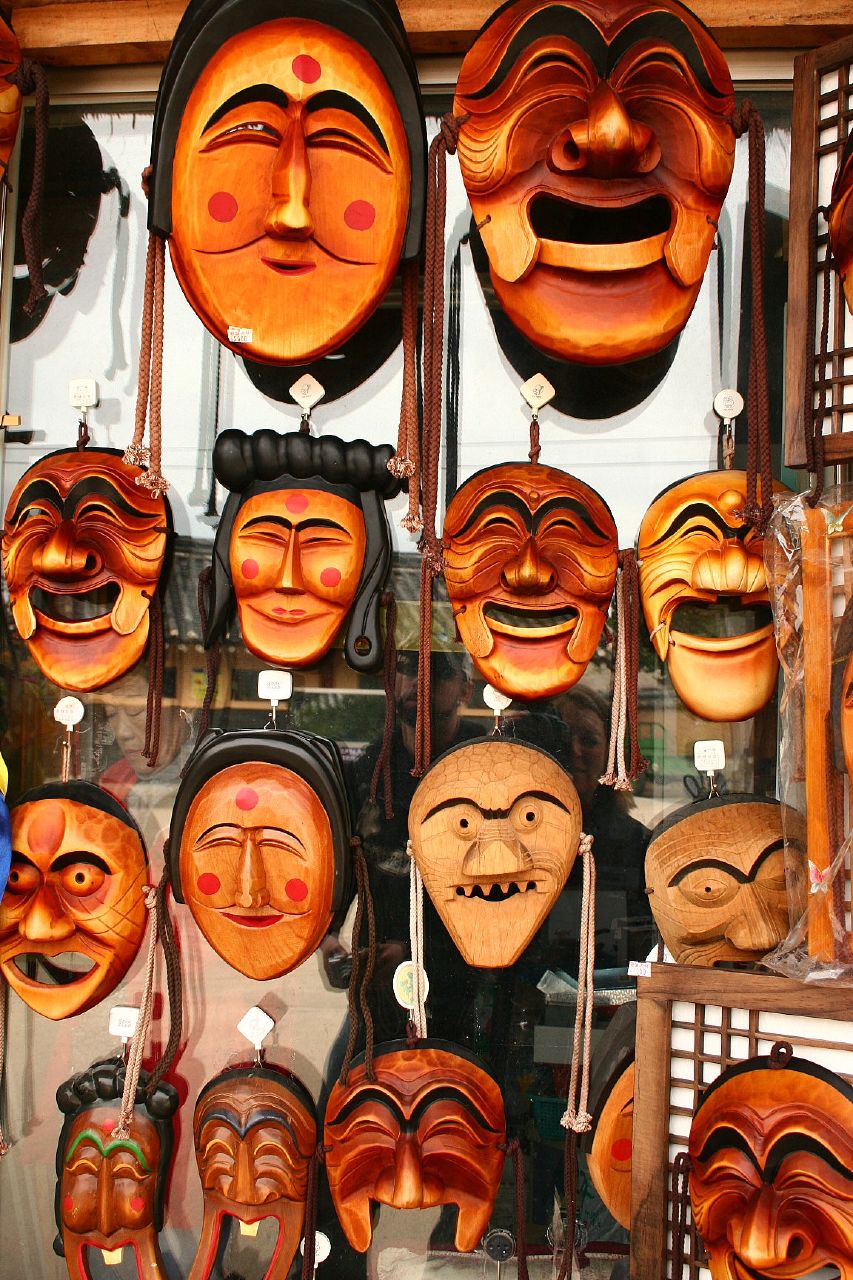
"So Mr. Heo started to work on the masks. He did not tell anyone else in the village about his dream. One day, a lady who lived in the same village and who loved Mr. Heo very much, his as she waited for him. She could not bear it any more at stole a glance at him. As soon as she did this, Mr. Heo fell down and died, leaving one Mask unfinished, Imae (Foolish Servant). This is why Imae Mask does not have a chin, as it was left unfinished." [note from me: can you find it in the photo to the right?]

"Villagers of Hahoe danced with the Hahoe masks (aristocrat, scholar, young bride, meddler, Buddhist monk, butcher, old widow, young woman and foolish servant) and finally danced the village back to peace. "
Even today, Hahoe is a peaceful and beautiful folk village where life seems to carry on much the same as it did centuries ago. And despite the busloads of tourists that come from around the country (and world) to sample a taste of traditional Korean life and enjoy its peaceful ambience, it maintains some semblance of authenticity, which is part of its subtle charm.

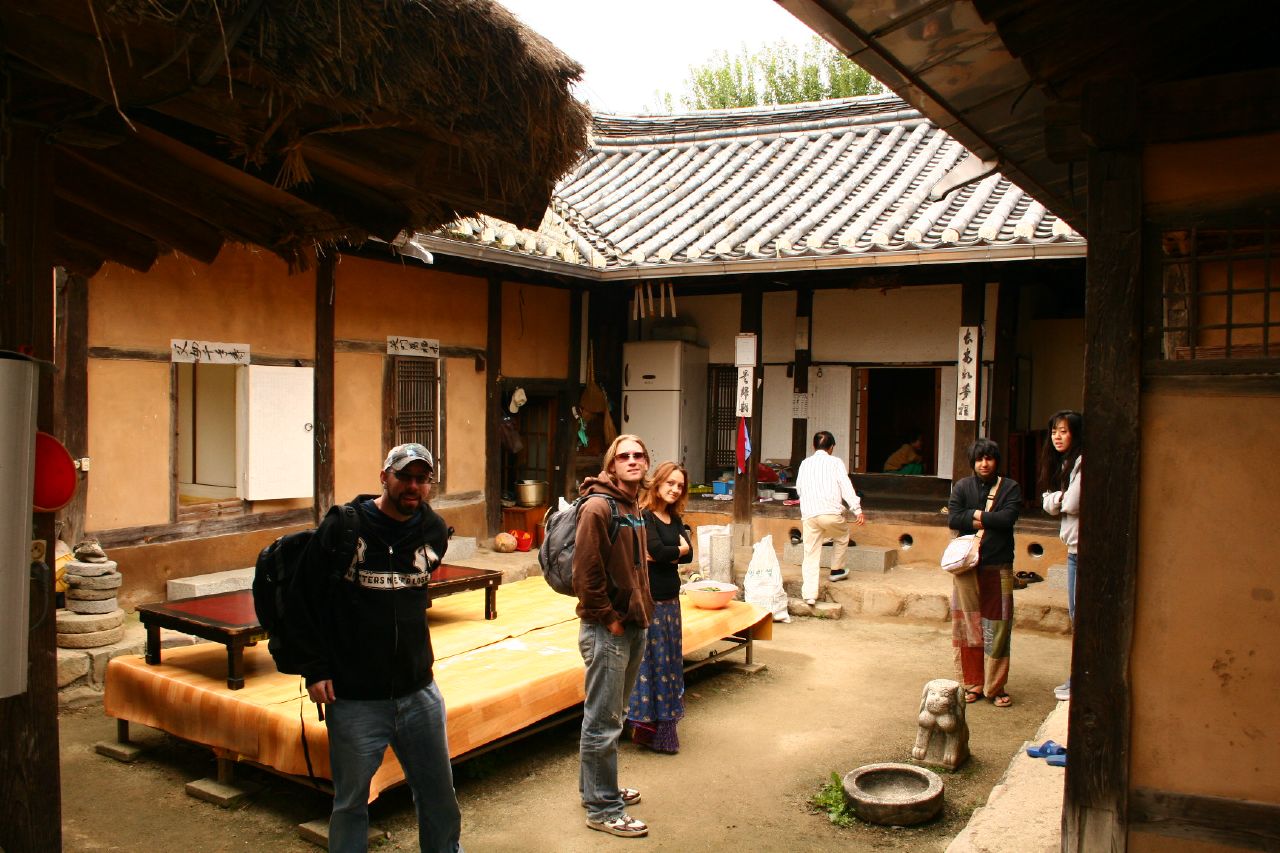
This past weekend, I had a chance to spend a chilly night and leisurely morning soaking up the special flavor of Korean culture that Hahoe serves up on a heaping platter. I arrived by bus with a group of CouchSurfers (who converged in Andong from various points around the country) Saturday night, after poking around the festival grounds. As we stepped off the bus and into the dark night, I tugged at the cuffs of my jacket, pulling them over my hands to ward off the sting of the evening chill. We walked along a quiet dirt road which followed a riverbank until we arrived at the traditional house, Hagungje #13, which was our home for the night.

Though it was dim, as we stepped into the house, muted light emanating from an open door gave us a view of the house's unusual arrangement. It was built as a series of rooms, which comprised four outer walls, all facing an inner courtyard which was exposed to the open air. Short sets of cement steps led from the ground to any of a number of rooms, most of which served as sleeping areas. I peered inside one of the rooms and was intrigued by its small size and spartan furnishings. There was enough room for four or five bodies to lay sardine-style on a hard floor, and a "yo" (traditional Korean mattress) and stack of blankets to warm us. A window at the opposite end of the room, a simple wooden frame lined with rice paper which slid along a wooden track and latched with a fabric tie, was the only other decoration.
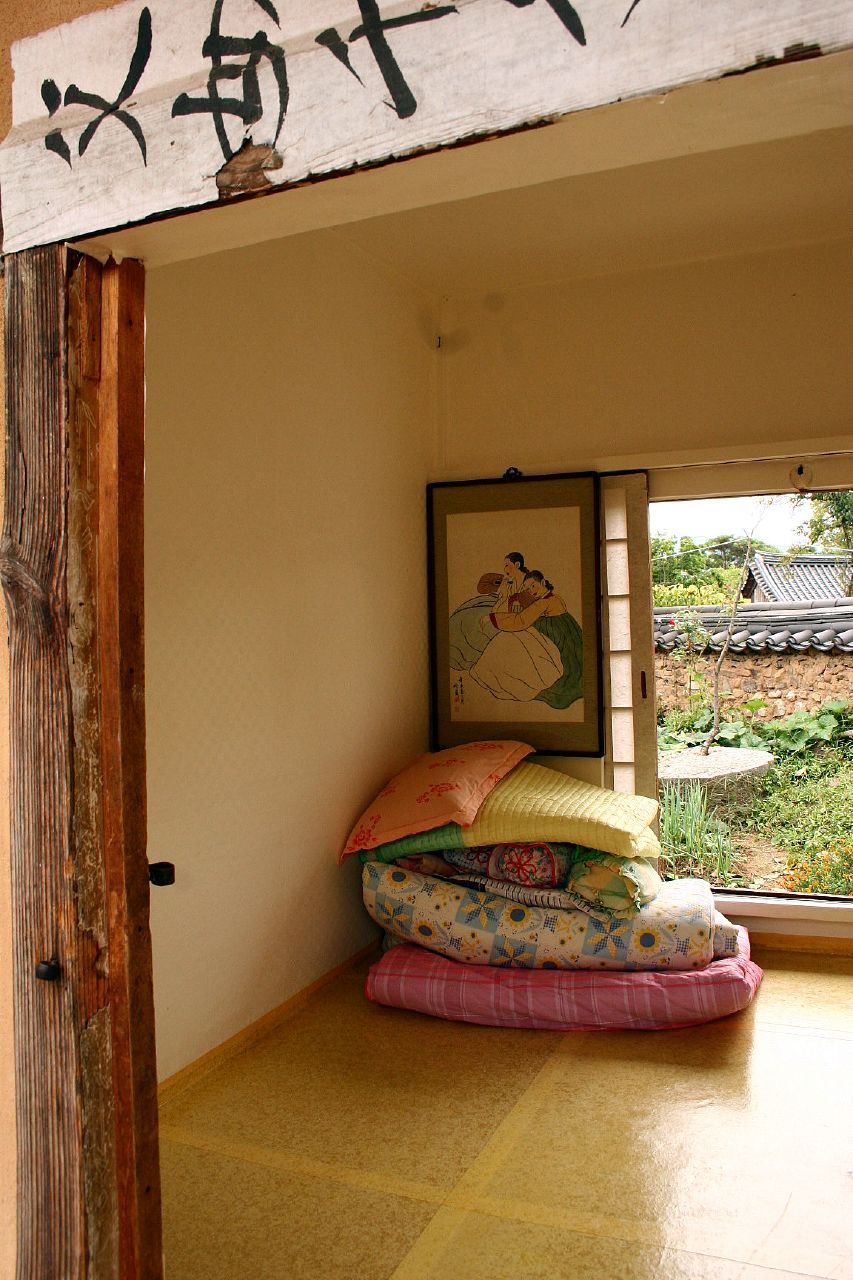
The kitchen, set in the back corner of the house, was bustling as the old couple living in the house began to prepare our dinner. After dropping our bags and removing our shoes, we stepped into the "dining room," a large, low-lying wooden slab near the courtyard. Although the table was quite long, our group was bursting in size, and we spilled over onto two adjacent round tables, filling up the entire area with our bodies and energetic conversation. The man of the house began what turned out to be an insanely busy job of waiting on the lot of us as we feasted on platters of steaming hot and spicy "jjim dalk," Andong's signature dish -- a mixture of chicken bits, glass noodles, leeks, and near-lethal doses of hot pepper (though somehow, I didn't think our dishes were deathly spicy).

Some of the group took off for the riverbank to watch fireworks, while others (myself included) stayed behind to finish dinner and warm up under layers of blankets. I later found out that this wasn't your typical fireworks show -- it was a special affair (...and I'm still chiding myself for missing it. I suppose there's always next year...) Seonyu Julbulnori, or traditional Korean fireworks, aren't shot from the ground, as are the festive explosions we're accustomed to. These fireworks are like gigantic sparklers strung above the ground. When they're lit, they create the ethereal feeling of falling stars or, as Roboseyo describes (and I quite like his visual), "bright flower petals floating to the ground."

[Check out this video footage from Roboseyo]

The rest of the night was a blur as round after round of soju and maggeolli found their way to our table, and the energy wound up before the evening wound down. Eventually, I retired to my shared room, tucked my too-thin blanket around my shivering body, and managed to settle into some sort of sleep (though between the winter chill and neighboring snorers, it wasn't particularly productive).

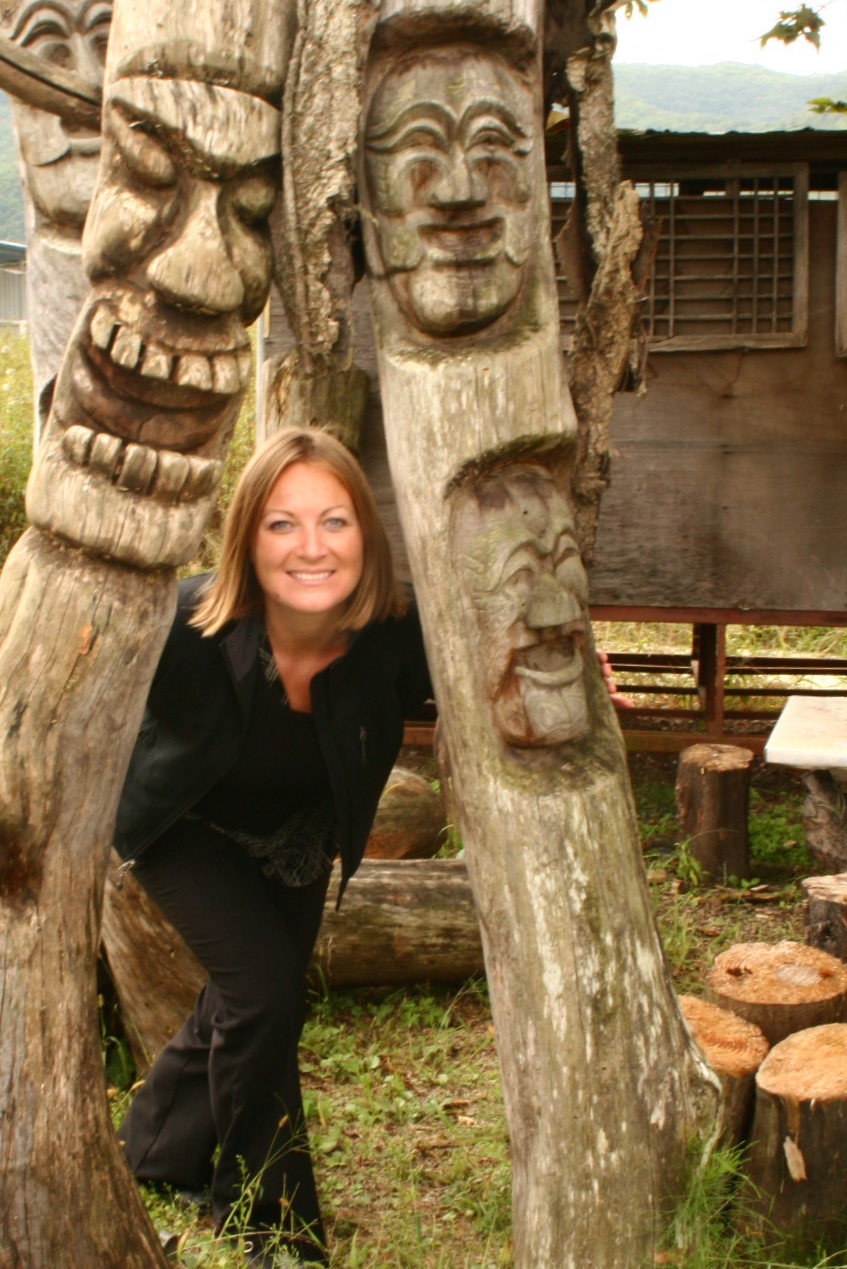
The next morning, after waking the the sounds of chirping birds outside our rice-paper window, new-found friend Adam (also an English teacher in Korea) and I did a little exploring around the village. We circled its perimeter, walking along narrow, dusty roads that tangled their way through the village, out to the edges of its rice fields and along the river, enjoying the peaceful pace of this rural respite from the busy world just outside its gates. We watched local farmers working in their fields, listened to the sound of wind blowing over vast carpets of rice crops, and even managed to find a litter of playful puppies. After putting our cameras to good use at some sort of wooden statue mini-park, we said farewell to our fair village and returned to the festival grounds to finish out the Maskdance weekend.

See more pictures of my visit to Hahoe Village here

Monday, August 18, 2008

Host a Traveler, Gain a Friend

After being the recipient of two fantastic CouchSurfing hosts during my recent trip to Busan and Daegu, as well as countless hosts during my months-long backpacking adventure back in 2006, the time finally came for me to play host. I've never lived someone exciting or exotic enough to lure travelers to my humble abode (Mechanicsburg, PA and Provo, UT aren't exactly hopping), and to be honest, I thought it would take quite a bit longer than two months in Seosan until someone found a reason to schedule a stop in my general direction.

But as it turns out, a fellow English teacher and American named Michael (who actually puts my transient history to shame) happened to land at my place over the holiday weekend. Michael, who has called Cheonan "home" for only a month now, is adjusting to life in one of Korea's more urban sprawls. And while living in the midst of high-rises and a menagerie of mandu shops must be quite handy when you're in the mood for munching, spending a little time off the beaten path, in small-town Seosan really must sound like a welcome respite from the throes of the cement jungle.

I had planned to spend some time this weekend showing Michael the surrounds of Seosan and experiencing them for the first time myself -- two months have passed and still I haven't managed to even make the 40-minute bus ride to nearby Palbong Mountain or the beaches in neighboring Taean National Marine Park. Mallipo, a 40-minute bus ride due west, was until last fall one of the pretties beaches along Korea's western shore. But unfortunately, an oil spill drenched its beaches, rendering it uninhabitable. After a widespread effort to clean it up and restore it for public use over the past several months, the reports from my students who visited Mallipo over last week's vacation were actually very favorable. And so it was that Mallipo made the agenda.

That is, until the weather made other plans. From Friday morning until Monday afternoon, rainclouds played games with us, blotting out any stray rays of sunshine trying to peek through, sending down light sprinkles that would last for hours, stretching their grayish-white mass across the skies like double-thick cotton candy. Michael and I spent the better part of Friday chatting at the bistro table in my apartment, stopping a few times for a pot of tea or a plate of spicy noodles and eggplant.

On Saturday, I took Michael on my walking path that cuts east behind some high-rise apartment buildings into a typical cross-section of rural farmlands, rice fields, and swampy reservoirs. I always enjoy this peaceful 3-mile path; you can literally smell the freshness in the air as you step into farm territory. We watched an old but sprightly fisherman poling his small boat through the shallow swamp waters with a long bamboo staff, and returned hellos from curious locals looking on wide-eyed at the sight of two waegooks (foreigners) footing it through the backroads of Seosan.

Back in town, stomachs gurgling, we walked to Koggiri (Korean for "elephant"), famous for serving up Seosan's best bibimbap. But my attempts to order up a late lunch deadpanned, so we took off for downtown to hunt down lunch Russian Roulette-style. We wandered up and down side streets for the better part of an hour (maybe more!), before getting up the nerve to drop into one of the completely empty mom-and-pop-shop restaurants and fumble over the menu. I dropped the few Korean words I know for dinner foods -- bibimbap (met with an inquisitive stare), naem myul (more stares), and jigae (which registered with Pop, as he subsequently replied with, "Kimchi jigae!" and a smile, and ushered us to a table).

Ten minutes later, we were sitting cross-legged on the floor of the shop, smacking our lips over seaweed salad, salted radish, kimchi, and a handful of other tasty banchan. Pop brought a black pot filled with a reddish broth to our table, flipped on the burner, and seconds later, the mixture was boiling before our eyes. The combination of spicy kimchi and salty pork, spooned over rice, was the perfect solution for two strong appetites. We managed to finish nearly every morsel at the table, including two cups of coffee (which is, amazingly, almost always complimentary after your dinner meal in Korea), and made out like bandits with a total bill of approximately $10.

The rest of the weekend was a blur -- a visit to the local movie house to catch the new Batman flick, a night hike to the observation tower overlooking the city, a leisurely breakfast of home-cooked rice pudding, another hike through the farmlands, all interspersed with an immense amount of conversation. By the time I left Michael near the bus station on Sunday, my head was reeling with saturation of thought, and my insides felt exhausted from the intensity of a very full weekend. Not that it wasn't well spent; it was. Host a traveler, gain a friend -- at least, that was the end result of this weekend's adventuring. I was due to be on the giving end as a host, and yet, one can never give anyone without receiving in return. And although it might take me a few days to recover my energy (yes, I'm an introvert by nature), the experience of welcoming a stranger and parting as friends is one I hope to have again and again.

Friday, August 8, 2008

Handwritten Histories in Haeinsa

Thanks to what I can only surmise was a bad combination of an intestine completely stripped of all healthy bacteria (antibiotics will do that to you) and a rather large helping of mountain spring water from Wednesday hike up Mount Namsan, I spent the better part of today with the Korean equivalent of "Delhi Belly." I really shouldn't complain; I wasn't stuck on a bus somewhere or out somewhere with Mother Nature, miles from a porcelain throne. My body even had the decency to hold off until I had some quality reading material to keep me occupied in between potty trips. There's nothing pretty about a bout of traveler's diarrhea, but it is what it is and there just ain't no getting around it.

Finally, by early afternoon, my body seemed stable enough to consent to me taking a day-trip by bus to Haeinsa, another of the glorified Buddhist temples (and a UNESCO World Heritage site at that) sprinkled among the mountainous footholds of Korea. What makes Haeinsa famous isn't so much the temple itself as what it houses: 81, 340 carved wood blocks, on which are written by hand the entire Buddhist scriptures. Known as the Tripitaka Koreana, these ancient records have been passed down for nearly 1,000 years (although apparently the current records were recreated in the 1200's after invaders destroyed the originals). They are one of the world's most complete records of sacred Buddhist texts.

I was fortunate to visit Haeinsa late in the afternoon, while clouds misting through the mountains of Gayasan National Park, which border Haeinsa to the west, kept the air cool and the mood mystical. On the road sloping into the hills where the Haeinsa temple resides, families walked together along waterfalls and over bridges, the sing-song of their voices hanging in the air like the low-lying clouds just beyond reach.

I took a short detour which led further down the road past the temple's main entrance, to a hermitage and a side road lined with brightly colored lanterns. A cool breeze blew through the leafy branches, and rippled through the lanterns with the softness of feathers. A monk, dressed from head to toe in a long, gray robe and loose cotton pants, walked in silence along the shoulder of the road, a cane in his right hand. There was nothing but the soft patter of his footsteps that could be heard above the rustling leaves.

Returning to the temple complex, I joined other temple visitors in walking through what appeared to be some kind of meditative maze, a system of concentric pathways leading in one fluid course from entrance to exit, folding in on itself and back out again in four geometric quadrants. Respecfully, we each walked in silence, our palms touching lightly as if in a posture of peace or prayer, eyes focused on the perimeter of the path marked with raised stone along the dirt-covered ground.


Climbing above the pagodas and the maze on a series of stone steps leading to another, much larger group of buildings, I looked back to see a frame of gray-blue mountain peaks jutting out from just beyond the borders of Haeinsa. In the late afternoon light, the scenery was poetic.

I continued walking along the outer walls of four earth-colored buildings before recognizing them as the rooms holding the Tripitaka Koreana. Through slats in the walls, I peered in at row upon row of books lining wooden shelves, carefully housed within the confines of the temple. I watched as an elderly monk, his body cloaked in loose-fitting linens, took a young boy by the hand and led him into one of the special-access libraries. His face was curled up in a smile as he pointed out sacred texts to the boy. I watched for a few moments longer through the slats before descending back towards the pagodas, back towards the temple entrance, back towards the road where I would meet the bus returning me to big-city Daegu once more.

The rest of the evening was a blur. I made it back to Bron's place in time to shower and change, and head off for a little nightlife with him and some of his foreigner friends. Quite in contrast to my day of rest and old-world reverie, and probably against my better judgment considering the state of affairs of my stomach just this morning, we swigged a few pots of maggeoli (traditional Korean rice wine) down the hatch, along with a few yummy side dishes, pajeon (vegetable pancakes) and dubu kimchi (kimchi cooked up with pork belly and served with heated squares of tofu). Maggeoli was another "first" for me, and before I knew what hit me, my head was spinning with the familiar reminder that full-blown overindulgence wasn't far off.

Near midnight, I bowed out of the party with Bron (who had a teaching gig the next morning), and we stumbled back to the Sinchon River area to his flat, where I promptly got horizontal on the two-seater sofa and tried to still the seesaw in my head. Between dongdongju in Busan, the soju fest at Hanjin Hostel, and tonight's indulgence, I was ready to take a break from the bottle for the rest of my vacation. But while it lasted, I certainly had managed to find good company to celebrate my vacation time with. Tomorrow marked the last day of my trip, and as I tumbled into a deep sleep, I vowed to make it one to remember.

Thursday, August 7, 2008

Blue Skies from Bulguksa to Daegu

My last day in the Gyeongju area was nearly perfect -- a naked blue sky, not a cloud in sight, and plenty of time to take in a day-trip to nearby Bulguksa Temple and Seokgoram Grotto. After a leisurely morning at the hostel, I packed my bags and took them down to reception to be stored after I checked out. I was leaving for Daegu later tonight, another hour west by express bus from Gyeongju. After a quick stop at the bus terminal to buy my onward ticket, I crossed the road and waited for local bus #11 to arrive.

The bus stop was filling quickly with Korean day-trippers heading to Bomun Lake for a day of water slides and carnival rides, and I was happy to get a seat as the last couple dozen to board were left with standing room only. Although only 16 km from Gyeongju, the ride to Bulguksa took the better part of an hour, as the bus careened along local roads, stopping every few minutes for a stoplight or to swallow a new passenger in its vinyl-padded bucket seats.

Finally, we arrived at the entrance to Bulguksa and within a moment or two, I had entered the temple grounds. I have been to a number of palaces and temples over the nearly two months that I have been in Korea, and while all have been impressive and beautiful in their own way, this temple in particular seemed to have some special magnificence.

It could have been the two stone pagodas standing majestically within the courtyard of the temple's main complex. Or perhaps it was the stairway carved in thick, gray stone, leading to the temple's main hall. It was upon this stairway of 33 steps, representing the 33 heavenly worlds of Buddha (or stages of enlightenment), that nobility during the Silla period would step.

But I tend to think that what set Bulguksa apart was the simple ambience of towering trees, meandering trails, and happy-go-lucky families lining their children up for photos among lilies and beside temple facades. All of the giggles and chatter and smiles seemed to breathe an easy air into this historically spiritual hotspot. And it was contagious. I found myself enjoying the sea of people coming and going as the scenery itself.

Then it was time to make the upward climb from Bulguksa to Seokgoram Grotto, another UNESCO Heritage site, where ancient carvings of Buddha and many other dieties have been preserved since the 70o's. The hike itself, apart from the oppressive humidity, led along a shaded rock-strewn path, climbing upwards into the mountainside. Unfortunately, I don't have much to say about the grotto. I felt disappointed with its size, and with the fact that the statues themselves are all carefully protected between a thick wall of plexiglass. The W4,000 entrance fee seemed a bit exorbitant considering the lackluster attraction. (Or, maybe I've just been spoiled with so many stellar finds around Gyeongju and Namsan mountain.)

Back at the car park, I began a series of bus rides to take me back the way I came: first to Bulguksa, then to Gyeongju, where I collected my bag and picked up a plate of kimbab for dinner, and finally on to Daegu, Korea's third largest city and the last of my bases from which to explore during my week of backpacking south-east Korea.

At 9:30 PM, I met my CouchSurfing host, Bron, in downtown Daegu, and began our walk back to his flat just a stone's throw from the Sinchon River, which runs north-south along the eastern fringes of the heart of the city. An hour later, I was showered and comfortably splayed out in his two-seater leather sofa, my home for the next two nights. I had been eyeing a book sitting on his bookcase, a novel I had months ago written onto my "Books to Read" list, yet had never gotten around to buying. Khaled Husseini's "A Thousand Splendid Suns" was calling my name, and after getting the go-ahead from Bron, I pulled it off the shelf and began picking through its pages.

Sleep hit late for me that night, probably more the consequence of my new reading material than anything else. Finally, around 1 AM, I cut the lights, closed my eyes, and drifted off to sleep. For the next seven hours, it was just me, the leather couch, and one pesky mosquito to keep me company...

Saturday, August 2, 2008

Backpacking Begins: The Bullet Train to Busan

Despite nearly cancelling my travel plans due to complications from my nasty Fido attack, I decided Thursday afternoon that I was well enough to still make the most of my one-week vacation (which began Saturday morning). It was cutting things close by Thursday when I made the final call, close enough that all hostels in Busan were booked, and I had to reserve my second-choice bullet train from Cheonan, as all seats on Saturday morning's first train to Busan had all been reserved.

The next few days were a bit stressful as I sent off multiple CouchSurfing requests in hopes of finding someone who would be willing to host me. I hadn't realized until far too late that the weekend of my intended arrival was also the beginning of a huge month-long beach festival in Busan proper. And everybody, it seemed, was planning to attend.

I managed the good fortune of getting in contact with a sweet girl named Marina, originally from the Ukraine, and on teaching contract for a year in Busan. Although she wouldn't be back from the Rock Concert until Sunday afternoon, she offered to leave me her keys so that I could help myself in to her flat and crash at her place for the night. This is the spirit of CouchSurfing, which is something that, try as I might, I simply can't seem to successfully explain to friends and acquaintances curious about this worldwide travelers-helping-travelers community.

Yes, Marina and I were complete strangers. Yes, she was leaving me the key to her place. Yes, I have done the same. And yes, people really can be that trusting.

Saturday was a long one -- I was up Friday night until far too late (2 AM!) catching up with a few close friends, tying up loose ends, and packing up for a week of backpacking. It had been a while since I was last in "backpacking mode," and I have to admit that my efficiency was terrible. But finally, a few slim hours before my bus would pull out of Seosan's terminal and route me to Cheonan (where I'd catch the high-speed train to Busan), I managed to fall into bed and passed out without a moment's hesitation. Finishing up all the odds and ends (watering my lily, taking out the trash, etc. etc.) took me longer than I had planned and, after running to the nearest taxi stand, flagging down an empty cab, and flying down the quiet Saturday morning streets of Seosan, I made it on the bus with just a minute to spare before my one chance of making my connections slipped out of my reach.

Several hours later, I was in Busan, standing in a mob of people waiting to purchase subway tickets in one of Busan's busiest metro stations. Marina had called me while I was en route on the train, and I had quickly scrawled onto a corner of my guidebook page her detailed directions on how to reach her apartment somewhere in the middle of Korea's second-largest city. After managing to get my metro ticket and board the right metrorail train, I settled in for what turned out to be another 45-minute commute uptown to the Oncheonjang stop. As it turned out, Marina's directions were flawless; within the space of another 20 minutes, I had unearthed the key from a potted plant one flight up from her apartment entrance, and was sopping the perspiration off of my face with the hem of my blouse. I had forgotten how oppressive high-summer humidity can be, especially with a 20-pound backpack strapped to my back.

After settling in, repacking the bare essentials into my daybag, rehydrating myself with some cold water, and giving my guidebook a quick once-over, I decided that my best plan of attack would be to head to Beomeosa, a Buddhist temple set in the mountains of Busan, and one of the city's finest attractions. Navigating a foreign country with little to no language skills always proves to be an interesting undertaking -- depending on the amount of patience involved, it can be either humorous or irritating. Fortunately, even with sideshow of a toothless man dressed in camouflage and combat boots who insisted on blowing me kisses for the entire bus ride up in the mountains, I was able to keep everything in a pleasant perspective. That is, until I walked onto the temple grounds, drew out my SLR to take my first photo... and discovered that I had failed to install the battery...

That discovery put an immense damper on my explorations, but soon I was reveling in the silent peacefulness of the temple grounds, craning my neck upwards to the tops of the bamboo shoots springing up alongside a temple wall, eavesdropping respectfully on the chanting and song of monks and worshippers kneeling barefoot in the inner chambers of many of the prayerhouses. A monk dressed in simple brown clothing stepped out from behind a closed gate and began sweeping the stone steps leading up to the entranceway, and a gaggle of school children, dressed in matching yellow tee-shirts, pattered through open courtyard, both bringing a unique energy to the scenery and stillness surrounding me.

After soaking up the whole experience, I managed to make it back to Oncheonjang and rounding up a few days' worth of fruits and vegetables before my body all but caved in from exhaustion. I had Marina's flat to myself and, despite the charms of Busan beckoning from just beyond her windowpane, I knew that what I needed more than anything was some quality sleep. So I curled up on the hard wood floor with the novel I had borrowed from Tahira just before leaving, and let the written words lull me to sleep. And despite my best intentions to venture out again later that evening, I managed to sleep almost straight through til morning on that hard wood floor. My vacation had officially begun.